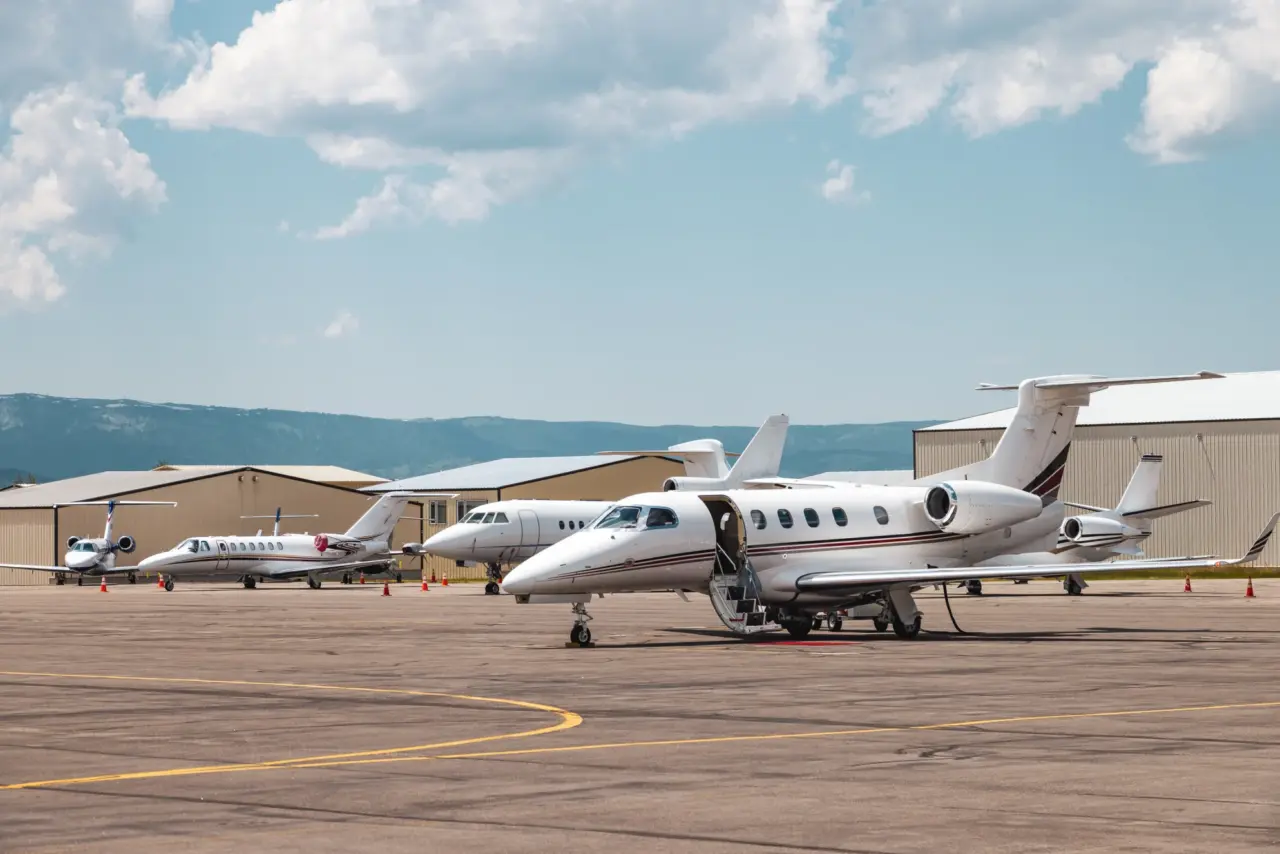
Trying to park your yacht is so 2025.
Now, the wealthiest consumers are fighting over places to land their ever-larger private jets. And more than ever, they’re making decisions on buying a luxury property based on how close it is to a private airport.
“Private aviation is no longer reserved for a small group of established executives,” said Matt Ellingson, senior sales director Stanly Ranch Residences, Auberge Collection in California’s Napa Valley. “A younger generation of entrepreneurs, business owners and professionals has embraced private travel as a practical part of their lifestyle.”
Stanly Ranch, for instance, is 6 miles north of Napa County Airport.
According to aviation intelligence firm Jetnet, private jet flights increased 13.4% globally in the first five months of 2026 compared to the same period last year. The report attributed part of the growth to an explosion of wealth from IPOs related to AI and companies including SpaceX. At the same time, the kinds of planes favored by the newly wealthy take up more space, require more runway, and need bigger hangars than some private airports can accommodate.
“Jets are getting bigger and more capable, and that’s changing market dynamics in real estate,” said Liam Bailey, partner and global head of research at Knight Frank in London. “For developments relying on a very wealthy clientele, proximity to an airport is critical. It’s the driver of that development’s economics.”
Knight Frank’s June 2026 Wealth Report linked the surge in private jet travel to a parallel rise in “multi-location living” for high-net-worth consumers; the report also noted that 47% of first-time private flyers in the first three months of 2026 were younger than 45, a record high.
“We’ve seen the same issue with yachts,” Bailey said. “Clients bought them bigger and bigger. They wanted to buy a second or third home, and park the yacht nearby. But some yachts were getting so big that marinas couldn’t accommodate them. The tension is similar here. People want proximity to an exclusive property, somewhere off the beaten track. But the infrastructure in many locations does not keep up.”
Private airports that were “accessible” a decade ago may no longer work for today’s larger private planes. “Investments are needed in longer runways and other improvements to accommodate newer jets,” Bailey said. “There’s a mismatch between these jet owners and developers who are trying to attract them. But who’s going to pay for the airport upgrades? Some clients want remote destinations, but you can’t always land the jet where you want. Small Greek islands can’t accommodate massive jets.”
For some developers, building close to private airports with updated facilities has meant even higher asking prices for top-end properties. Such was the case at Tributary, a 1,500-acre private resort in Driggs, Idaho, that’s half a mile from Driggs-Reed Memorial Airport.
“Proximity to private aviation has become a defining status amenity, and that has allowed us to enhance prices even more,” said Spain Short, director of real estate at Tributary. “I talked to a prospect who lives in Aspen, but can’t land his plane there, because it’s too busy. So he has to fly to Eagle, an hour away. Tributary was appealing to him for that reason.”
At 7,300 feet, the Driggs-Reed runway “is 1,000 feet longer than Jackson Hole, which accommodates commercial flights.”
At Optima McDowell Mountain, a 22-acre mixed-use development in North Scottsdale, Arizona, nearly 10% of property transactions were “related to proximity to Scottsdale Airport,” according to David Hovey Jr., president, COO and principal architect of developer Optima, Inc.
Properties at the development range from $600,000–$5 million. “When you fly into Scottsdale Airport, you’re basically flying into the project,” Hovey said.
Meanwhile, commercial travel is plagued by indignities, from the chaos of airports to waves of mass delays and cancellations.
Greater friction in commercial travel means a growing appeal around flying in their own plane.
“Even with programs like TSA PreCheck and Global Entry, traveling through commercial terminals is more of a hassle, with longer lines and more unpredictability. You could get through in 10 minutes one day, and 90 minutes the next. That’s not something high-net-worth people like,” said Dan Scott, residential real estate broker at the Whitetail Club, a residential development in McCall, Idaho. “We’re less than 3 miles from McCall Aviation. It doesn’t change our pricing, but it definitely increases demand.”
In the meantime, living near a private airport will only keep growing in importance for ultra-high-net-worth buyers, Ellingson said.
“One of the unique aspects of proximity to a private airport is that it is a permanent locational advantage,” he said. “Amenities can be added and homes can be renovated, but accessibility is something that can’t be replicated or relocated.”